
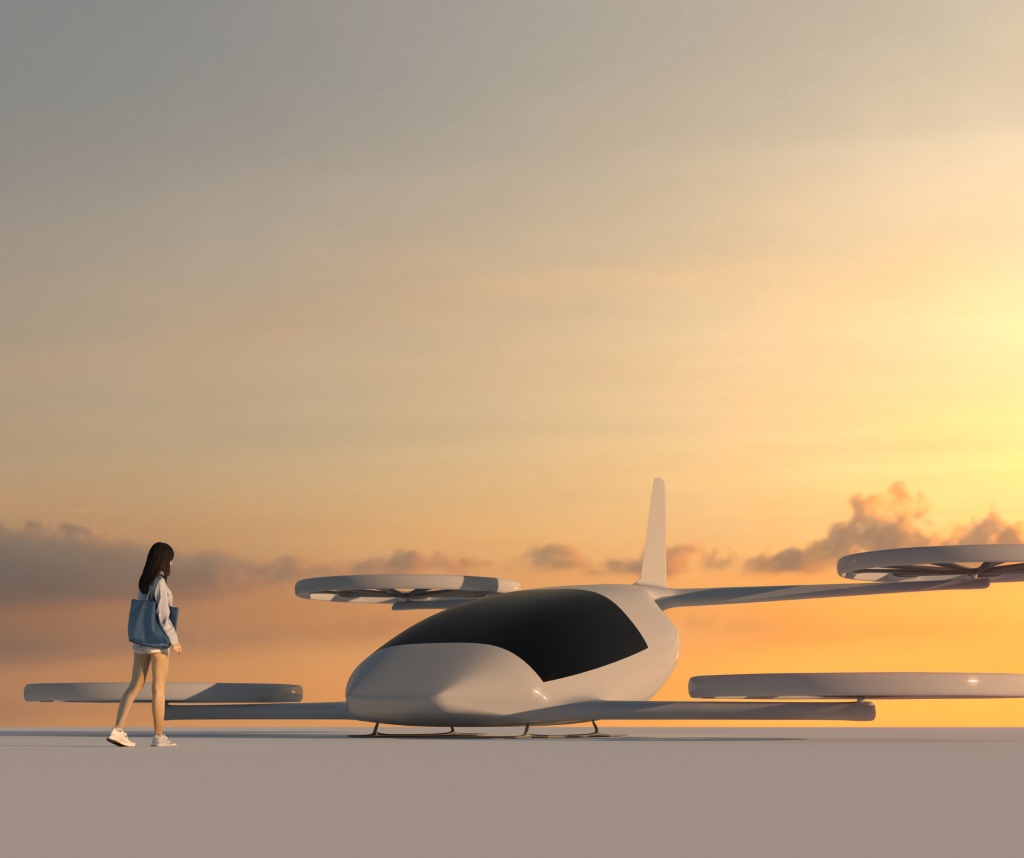

eVTOL air taxis could be the new efficient means of intercity travel with zero-emissions short flights. Whilst they may resemble helicopters, they could be far more cost-effective and environmentally friendly in the long run.
They are similar to aeroplanes in their rotor-enabled forward flight. With their electric propellors powered by batteries, new designs and innovations are broadening the market.
eVTOL vs Aircrafts
eVTOL (electric vertical take-off and landing) vehicles are cheaper and more accessible to manufacture than helicopters. They promise to be available to a broader consumer base. Their fuelling costs are much lower, with their rechargeable energy source inside and fewer critical moving components.
Lower maintenance costs will also drive these prototypes to hit commercial markets. IDTechEx figures show a maintenance cost of US$112 per flight, just 25% of that of a helicopter flight.
Runways and complex infrastructure won’t be required, as eVTOL air taxis take off similarly to helicopters without having to gain ground speed before takeoff. Noise pollution that accompanies large engines will also not be such a concern, as eVTOLs are quieter due to smaller and innovative rotor designs and the use of eMotors. They may be approved to fly in more areas than helicopters without causing disruption.
Motor Characteristics
Safety is a huge factor to be considered alongside low disturbance and is one of many key factors for companies to prove in their prototype developments. With the many start-ups in the eVTOL vehicle industry, a few additional motor characteristics must be met to be a competitor in the market.
Power density for eVTOLs is crucial to enable high enough power for takeoff and landing while having a light enough body for efficiency and the best possible performance. Good control responses are vital for the safety and accuracy of movement so passengers can feel safe and secure when travelling.
Multicopters, tiltroters and tiltwings are some of the main types of eVTOL vehicles. While multicopters have multiple electric rotors to control flight, they have no wings, whereas some of the other kinds have stationary wings for efficient cruising. Many prototypes have been created, with a smaller number making it into the production stage.
eVTOL Challenges
Investing in eVTOL vehicles could be somewhat risky because they are so new, and nothing quite like them exists to compare their predicted success. However, the competitiveness appears to be great, with lots of start-up companies despite high costs of entry. There is also a lot of need for research and development within the industry, so choosing where to invest could be tricky.
Regulations that aren’t yet in place might also be difficult to implement, as there is no previous experience with such vehicles. Air traffic management will need to begin factoring in these new zero-emission vehicles once they enter the market so that they do not interfere with other aircraft and established routes.
IDTechEx further identifies some challenges with the decision to have eVTOL vehicles flown by a pilot and wonders whether autonomous vehicles are the best route to go down to free up space for an extra passenger.
Some problems are also predicted to be overcome with public acceptance of their noise, though limited, and safety aspects. Selecting which batteries are best suited for these vehicles is also a consideration. The IDTechEx report ‘Air Taxis: Electric Vertical Take-Off and Landing (eVTOL) Aircraft’ finds lithium-ion batteries best suited for such aircraft.
eVTOLs will be most feasible for travelling between cities at distances over 50km, for example. Still, battery and charging technologies will need to improve for this to happen successfully. These air taxis also face competition from high-speed rail, with the costs of their journeys making them less accessible.
Comments are closed.