


With the electric construction machine industry still so young, there is yet to be universal adoption of the technology worldwide, and some regions have been able to steal a march over others. While China may be the market leader in 2024, IDTechEx’s “Electric Vehicles in Construction 2024-2044: Technologies, Players, Forecasts” report predicts that the US will replace China as the world leader in unit sales by 2044.
China’s place as the leader in electrifying construction machines follows a long history of proactive electrification in various heavy-duty mobility sectors. Chinese companies have plenty of experience in this area and a well-developed battery manufacturing supply chain, both of which they have been able to bring into the construction space.
OEMs have been buoyed by policies and favorable economic conditions to develop new electric machines, which have seen success in the Chinese construction industry, which has increased in the last decade. Cheap electricity prices have also meant that customers can charge their machines quite affordably.
Electric machines in China are now relatively advanced. OEMs are mainly turning away from developing electric mini-excavators or compact loaders and instead focusing on more giant machines – huge excavators, wheel loaders, and mobile cranes. These machines are widely used in China and emit most of all construction equipment, so it makes sense that OEMs have invested plenty of resources into their electrification.
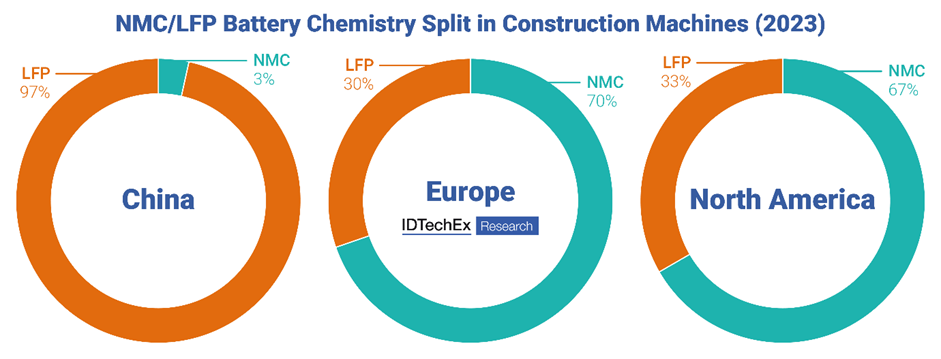
IDTechEx’s analysis of over 200 unique construction machines shows that LFP battery chemistry dominates Chinese models. LFP is the preferred chemistry in the Chinese mobility market, meaning OEMs likely have a better supply, but it is also more suitable for more giant construction machines.
LFP batteries are cheaper per kWh basis, so the high-capacity batteries needed for significant construction machines can be more affordable. At the same time, LFP’s lower density/higher weight is not much of a concern for machines that are already heavy and often require additional ballast.
Unlike China, Europe and North America generally prefer NMC chemistries in their construction machines.
How Is the Landscape Evolving?
Electric machines were quick to get off the ground in China, but the industry’s growth may not be so rapid. For one, the larger electric machines produced now will come at a more significant price premium than many smaller machines, which can drive potential customers away from purchase.
The Chinese construction market, in general, is also beginning to slow down, with machine sales in China declining significantly in 2023 for the first time since the COVID-19 pandemic. A lack of new government policies incentivizing EV development also means that Chinese OEMs may be less inclined to keep up the fast pace of progress.
Meanwhile, in the US, OEMs like Caterpillar and John Deere, which have been late to the electrification game, are beginning to embrace the industry’s transformation. Diesel is relatively cheap in the US, favouring conventional diesel combustion machines. However, diesel prices will likely increase long-term, driving EV uptake.
Today’s US construction market is among the biggest in the world, not far from China’s market in terms of unit machine sales. The big difference between the two is the types of machines each uses. Where China uses plenty of large excavators and wheel loaders, nearly two-thirds of machines in the US weigh 6 tonnes or less. Smaller machines are far more accessible for OEMs to electrify and come at lower price premiums, which is ideal for the growth of the electric machine market.
What Challenges Lie Ahead for the US?
The US market primarily uses NMC batteries, which are well-suited to electrifying compact machines. NMC provides high energy density, offering excellent runtimes within a small form factor. The challenge with NMC is its higher cost per kWh, which impacts the economics of electrifying larger machines.
If US OEMs begin to electrify large excavators and loaders using the same NMC technology, these machines could be too expensive for their target market. They may struggle to see the total cost of ownership benefits over a diesel equivalent.
Despite being tipped to lead in sales eventually, most electric machines in the US will be compact machines – mini-excavators and compact loaders. These bring in less revenue for OEMs, and IDTechEx expects the US market cap to still be smaller than in China.
The new “Electric Vehicles in Construction 2024-2044: Technologies, Players, Forecasts” report from IDTechEx presents granular 20-year forecasts detailing the growth and evolution of the electric construction machine industry in the US, China, Europe, and the rest of the world.
Comments are closed.