
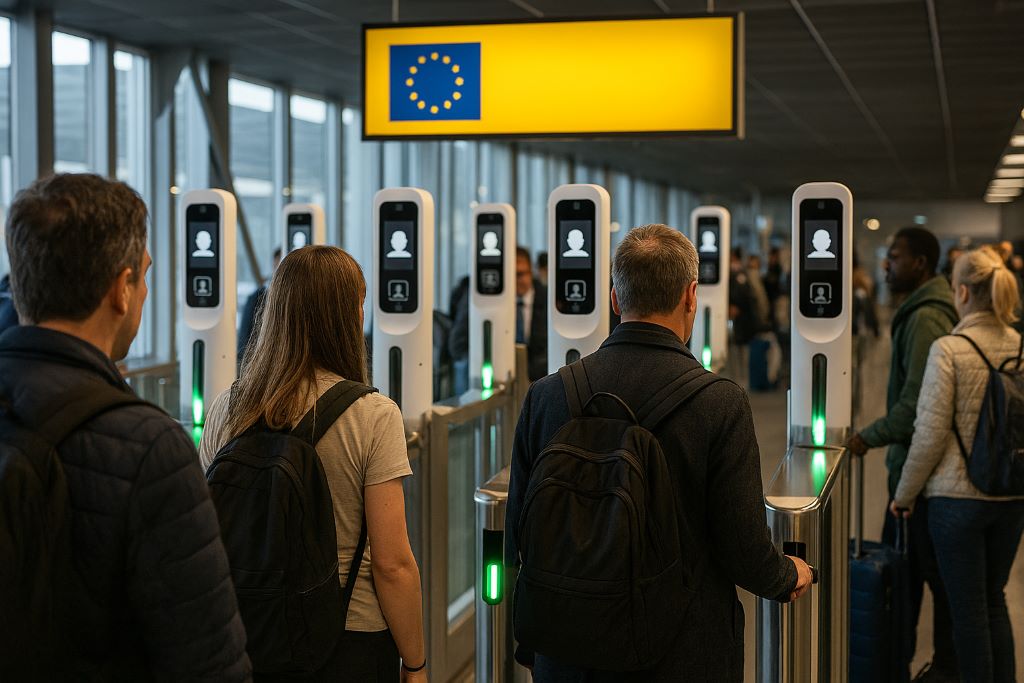
 AI-Generated Image for Illustration Purposes

As Europe rolls out its new biometric Entry-Exit System (EES) for non-EU travellers, airports and travel operators warn that border controls are already causing significant arrival delays, with knock-on effects across the wider travel experience.
Passengers entering the Schengen Area from non-EU countries are now required to register biometric data, including fingerprints and facial images, on their first entry.
Industry groups representing airports have warned that the new system has increased passenger processing times at border control by up to four or five times, with reports of waits lasting several hours at peak times.
While much of the focus has been on passport control, the disruption does not end there, says Ričardas Šukys, CEO of Woop Drive, a platform that introduced a fully digital car-rental service at airports.
According to him, delayed arrivals often lead to congestion at car-rental desks, transportation pickups, and hotel check-ins, particularly at high-traffic leisure destinations during holiday periods.
The latest data by the International Air Transport Association shows that global passenger numbers are expected to surpass five billion this year. Pressure is growing on parts of the arrival process that still rely on manual checks, queues, and in-person verification.
In response, some operators are accelerating the shift toward fully digital arrival services. Woop Drive is one of the companies who have just launched a digital car rental platform with desk-free, app-based rentals across several popular destinations for non-EU travellers, including Greece, Spain, Montenegro, the United Arab Emirates, and Seychelles.
They believe digitalisation is the solution to prolonged processes. Rather than collecting vehicles at traditional rental counters, such platforms allow travellers to complete verification and access their cars via a mobile app, avoiding queues and in-person paperwork, an issue that is only going to become bigger for non-EU travellers.
A recent J.D. Power study found that skipping the counter alone results in a 36% faster pickup and increases customer satisfaction by up to 8%.
“Border control is becoming more complex for non-EU travellers, and that pressure doesn’t stop once passengers clear passport checks,” said Šukys. “As arrival times become less predictable, services that still depend on manual handovers are increasingly exposed to delays. We wanted to change it immediately.”
Airports and travel associations have warned that the situation could worsen over Easter and the summer peak, particularly when multiple flights arrive in short succession.
Travellers from non-EU countries should expect longer arrival times in Europe throughout 2026, especially during busy holiday periods. Some are now adapting their ground transportation and mobility offerings to reduce friction for passengers exiting border control.
Comments are closed.